Form follows function, follows feeling

0:00 / 0:00

If you have ever been to Vienna, chances are that one of the lasting memories you took from that trip is the cities beautiful ornamental architecture. Gothic churches, Neo-historic building facades, the famous Ringstraße-Buildings.

Vienna was not only the place where ornament reached its peak, but also where it was declared unnecessary. Adolf Loos stood up in 1908 and said ornament was a waste of time, money, and labor. A plain chair could last decades; an ornate one went out of style in years. He believed true beauty came from proportion, material, and use - not surface decoration.

That idea spread. It shaped Bauhaus, Braun, and later the golden years of Apple. The principle was clear: form should follow function. Reduce things to what they need to be and beauty will show itself.

This way of thinking influenced much of the 20th century. Over time, functionalism spread far beyond architecture. Into machines, into digital platforms, into the apps we use each day. Chances are that if you attend an intro course at design universities today, they will still teach you this guiding principle.

We got very good at it. Remarkably good. The principles worked - we built more housing, made tools more accessible, solved important problems. The functionalist victory was so complete we barely notice it anymore. Our cities, tools, and interfaces all speak the same language: clarity, purpose, efficiency, minimalism.

And yet, we also seem to have lost something along the way - our culture often feels thinner now. Yes, our lives became easier, yes we built more apartments and solved many important problems, but huge parts of our generational work seems to be lacking “soul”. We laugh about contemporary art like a banana on a wall, and are driven by nostalgia. We listen to songs from many decades ago, admiring paintings, buildings, designs from many centuries ago.

In comparison our generations mainstream culture feels flat, predictably enjoyable, designed to predictably make money. Movies made to please, songs made to repeat, apps made to capture attention. Useful, yes - but less nourishing. We became good at building for the head, less so for the rest of the body.

We spend more time looking at images of beautiful places than being in them. We interact with hundreds of strangers online, yet we became strangers in our own city. We admire Renaissance sculptures in museums but can't name a living sculptor. Tumblr accounts say we have lost god, and thus with Him our ability to build cathedrals that challenge those of ancient periods.

But as they say, there are cathedrals everywhere for those with eyes to see. Our world can only make sense if you experience it in its wholeness, instead of trying to live full, meaningful days through a keyhole.

In German, sinnvoll means meaningful. But literally, it means “full of senses.” Maybe what some would call a generational crisis of meaning is really just a crisis of over thinking, ruminating, of neglecting to live wholly. Most things today force us to process the world in our heads. We need to uphold ever more complex abstractions to keep up with a more and more complex society.

We waterboard our brain with information and wonder why we feel like shit. Our heads are overwhelmed, so we zone out and end up sleepwalking through life - thinking about meaning instead of noticing it. When therapists help overwhelmed patients ground themselves, they don't ask them to think harder or look harder - they ask them to name five things they can see, four they can hear, three they can touch.

Can we blame people for feeling stressed, irritated, agitated, “off” or meaningless, when today’s tools, environments and art is neglecting the richness of their senses? Can we blame them for not knowing that fast food is bad for them, that social media is making them more depressed? When the bright lights we use in schools make us stressed, that watching social media all day literally rewires our brain chemistry for the worse.

Science figured out a great deal not only about the mind, but about the rest of the body. Why good sleep is so amazing, why good food literally makes us happy. That ornamental architecture is not good for us because it is “pretty”, but because it calms our bodies because to its nature like patterns.

Why not utilise it more?

Imagine chairs designed not just for sitting, but for how they feel against your back, how their texture calms your nervous system. Digital tools that don't just solve problems efficiently, but consider how they make you feel after using them - energised or drained, connected or isolated. Buildings that engage all your senses - not just picture-ready facades, but spaces with natural acoustics, materials that age beautifully under human touch, proportions that feel right in your body. What would a social media platform look like if it were designed to make you feel more connected to your physical community? A productivity app that actually made you feel accomplished rather than anxious?

Point is, we need to start living fuller lives, outside our head. We cannot think our way into meaning. Thinking is part of it - analysis, problem-solving, rational progress all matter. But thought on its own is brittle. It loops back on itself, creating signs about signs until we become “lost in a world of signs, forgetting what they signify”. Our brain needs to ground itself with what it receives from its senses - sight, sound, touch, taste, smell. Without them, thinking has nothing to hold onto and we spiral into rumination, only ever getting closer to another thought, never a lived moment out there in the real world. For years I thought instead of lived. But thoughts are not life. Life only shows itself when you’re awake to it.

So in short. The metalayer is a trap, get outta there. Touch grass. Practice the art of noticing.

Maybe the next step for builders, artists and doers is simple: to design not only for function, but for wholeness. To let form follow function, and function follow feeling. To build things that outlast thought.

Maybe our tools, screens, digital information, technology, buildings can be be made more humane and, in turn, make us more humane.

We need to remember that a meaningful life - a 'sinnvolles Leben' - a life full of senses, can’t be achieved through thinking itself. We simply need to live.

So I ask you: Are you awake? Are you truly present? What would happen if your brain’s language setting would suddenly switch to chinese and best of all, without you being able to understand it? What remains? When and IF the fog clears, do you see with eyes unclouded by thoughts? Are you seeing the people around you or are you staring back into your thoughts? Was your struggle so far a fight fought in thought?

The ornament wasn't the crime. The crime was forgetting we have bodies, senses, and hearts that need more than mere function to flourish.

Form follows function. Function follows feeling. And feeling follows being awake :)

Writing post image

Maximum delight, Maximum Rejection

0:00 / 0:00

There's a fun challenge I like to do every now and then.

Every invention lives on a curve. Somewhere along the curve lies a strange point of providing people & the world with maximum delight, right before maximum rejection. Let me give you a concrete example:

You are a designer/engineer that can time travel back to the turn of the century. Somewhere between 1995 and 2005.

Given your current knowledge you have all of these products that might have already matured. Take the Mouse for example.

Today, you have n plus iterations of the Mouse. At what n could you bring it back in time without people rejecting it for it being "too" far fetched or incompatible with the rest of the technology landscape?

(Tony Fadell build book, example of team that tried to build smartphone too early)

Because maybe if you would bring today's mouse to a point where there already was a similar interface to today's one, they would not reject it for being too modern. And you would bring a better, more delightful product to people at an earlier point.

Or another example:

Could the iPhone have been invented five years earlier, without people rejecting the idea because it is too foreign?

At what point does that become a fact? Is it 2006? 2005? 1999? 98?

Because the next iteration would be so asymptotic to what you actually need now that you don't want it. Here is where the really big innovations live.

Because if you manage to build towards that point, you make a way better product way earlier.

But if you push a design too far forward on this curve, people won't or even can't want it. Not because it's bad, but because it is too far from what exists currently.

But right before that point, there's the furthest you can go while people still say yes. Maximum delight, maximum rejection, sitting right next to each other.

It is the local maxima on this innovation curve.

I call this the maximum delight before maximum rejection product. And I really hope you get lucky enough to build one.

Writing post image

Build a lightbulb

0:00 / 0:00

I love to go back in time and watch old product launches. The iPhone, the polaroid SX70, the Ford.

And if you back in time long enough, there comes a point where someone walked on a stage and presented a new product. That product literally being the lightbulb.

When we talk about product launches there quite literally is not a more difficult bar to beat. Not Salesforce, but something as fundamental as the lightbulb.

Those were the kind of products being announced at that time that propelled society forward immeasurably.

Now, for many reasons, it is obviously very difficult to invent something as changing as the lightbulb.

Trying to reach that bar, and finding innovations like this is very difficult. The lightbulb was as much of a innovation geschuldet due to a accompining breakthrough in physics as it was a new consumer product.

And nowadays, we have more and more competing ideas about what we think every one of us needs, while the need for light - being something probably few were opposed to at the time.

So when I'm saying can you create the lightbulb, I'm not saying can you create a new paradigm in physics that eventually leads us to the lightbulb.

I'm saying that when you walk up on that stage, can you present something that solves such a huge fundamental human problem, with something in a way as simple as a lightbulb?

Writing post image

Being a piece of it all

0:00 / 0:00

One thing I love to do when I'm on my bike and bored, agitated, or pissed at life, is to close my eyes for a second and imagine I am a lonely particle floating somewhere deep in space (yes this is stupid but bear with me).

And I'm out there, further than our solar system, galaxy, or even galaxy clusters. I'm literally just in dark, empty space. And then I just pretend that all I've ever known, my entire life as a particle, was just in this complete nothingness.

Then I slowly open my eyes, only a fuzzy glimpse at first. And I look and see what the first thing I can recognize is. Oh, a leaf!

Well, this is normally pretty standard, boring. It's fall, I see a thousand of them. But then I close my eyes again.

Now imagine YOU ARE this particle in space. You would go nuts over just a piece of that leaf!! Like EVERYTHING you have EVER known is just emptiness, nothing, nada. And now I give you this object that has texture, color, taste, smell. And by definition this thing looks like NOTHING you have ever seen before. 'Cause you literally have just seen NOTHING.

Then I open my eyes fully. And what I see is not just one leaf from one tree of one species. There is all that... somethingness!

Like we didn't just get one tree from one species, we got thousands of leaves from thousands of different types of trees. And all this other stuff. All the types of sidewalks, buildings, cars, people...

There is so much SOMETHING.

And then I am really happy. On my bike. Riding through all this somethingness.

Glad I didn't fall or cause an accident. There is no more awesome feeling than that.

People, we got so much stuff around us that you, if you were that particle, would literally kill for, even if it were just for a tiny piece of leaf.

Writing post image

Care

0:00 / 0:00

I was recently asked how I found work that I really enjoyed doing, that I was super passionate about.

And my answer quite plainly was: I forced myself to never think of work as a job. Even with money as a practical necessity, I always tried to shake off this notion of just getting a "job". I do want to say that, conscious of my protected and stable upbringing when compared to other parts of the world, this might fail to capture important nuances and might be more aimed towards the people who share this privilege with me. However, I do hope that regardless of your upbringing and background you can find some value in this.

We often forget that jobs were not created for us to have jobs; jobs just kind of came into existence because there was shit to get done and problems to be solved. And along the way of solving it, you got compensated for your effort. Not for the sake of having the job in the first place - that was a nice side effect.

But I feel like we don't see work like that anymore. We work for the sake of working, not for the sake of solving the problem that work was necessary for in the first place. Work is not a means to an end anymore; it is the end.

So how did I find something to actually work on? I simply cared.

I cared enough about a set of problems that I wanted to do something about them.

As a teenager, I was kind of depressed by all the problems people were talking about constantly. Climate change, poverty, all of that stuff. But while we were constantly confronted with these problems, rarely did the conversation focus around actually doing something about them. People learned to care about the problems, but not about the solution. That really bummed me out because how can you ever be optimistic about life if no one's doing something about the things you're worried about in the first place?

The problem is that most of us grew up being told that we can't care because we don't have the right ideas or agency to care. But we do. Most of the stuff around you was thought of by people with brains not that different from yours. Your ideas matter, if you just make them worth caring about.

So even though there is all this shit we are facing, there still is something worth living for in spite of that. There is something to care about. Life is worth caring about, and making sure life gets better.

So what I did is essentially decide that the best way out of this nihilism is to find my set of problems I deeply cared about and the solutions I wanted to see exist, push forward, and rally behind, which I did and now still do.

So if you struggle finding meaning in your work or something to do in the first place, look for something which makes life worth caring about. Things that you deeply care about. What problems move you? What do you want to get better at? Find a set of topics or people or things you deeply care about, you want to be better at, you want to help solve.

And then find the work that would be required to protect them from the problems threatening them, things required to come closer to a solution for these problems. And then just do it. That's work. And the job title or the position is just something secondary to that that emerges from that.

Care, and something to get done will follow.

Care, and work and a job and resources will follow.

Writing post image

Action

0:00 / 0:00

When I said that "care and something to get done will follow" I really meant it. But I did leave out a little nuance. Actually getting things done is absolutely, insanely notoriously difficult. Let me explain why:

Let's imagine you found something you want to work on, so your next thought likely is "What is the next step I can do now so that I can actually start to work on this set of things I care about?"

Now here is where things get hard. Let's go back a year in time: Last year I realised that from the moment when I first found the things I wanted to work on, to the present day, some five years later, I didn't feel a single step closer to a solution than I was when I first started imagining it. I thought, hmmm that's weird, since I had been literally thinking 24/7 nonstop about this set of problems from the moment I started caring.

What I slowly realised is, that my thinking or what better should be called my ruminating, had been an awfully convenient excuse for me to feel like I was DOING something. But the difference between thinking and ruminating is that rumination only ever gets you closer to another thought, never an action.

It was a really good excuse for feeling productive but not actually being productive. There was nothing tangible "produced" out of my thinking. But I had this feeling that if I just sat on a problem for long enough, the perfect solution would just pop out of my head.

I was looking for a single elegant, sexy solution to a set of complex, dynamical problems.

Life doesn't consist out of sexy solutions. What life actually is, is a series of duct taped solution along the way to the sexy one. One cannot simply skip to the 101st step when not even having taking the first one. It is very difficult to predict life that accurately in your head, no matter how hard you try. Trust me, I really did not want to face this, but don't let rumination trick you. Thinking is sexy, doing things will always be messy.

Essentially, I was stuck in a never-ending incubation process of the perfect idea.

But compound action and iteration beats perfectionism every single time. Because the one incentives you to do something, while the other will only ever tell you that you or the world are not ready, qualified, or smart enough... quite yet. If you want the things you care about to turn into reality, then there's no way around engaging with reality.

The irony is that while all of this was happening, I happened to get an actual external opportunity to work on some of the things I care about. Dembrane, a company I had reached out to some time ago, responded and gave me the chance to work with them on building tools to aid participation in democracy. Being persistent with passion worked out that time.

However, it was awfully hard to commit to it - to say yes. Because it was scary. It was outside my comfort zone. And because I realised that every time things got a tiny bit inconvenient, like in this case, I tended to return right to my thoughts - ruminating about life rather than living it.

I was so scared to "fail" or not be perfect in my pursuit of solving the problems I care about, that I refused to actually just do something to get there.

I was letting my ego get in the way of committing to my work, actually putting the process of solving the problems first, not the need for elegant solutions I can identify myself with.

So I said yes to the job. And also yes to all the scary stuff - Me being faced with the awful reality that my actual tangible day-to-day skillset mismatched massively with the perceived quality of all these thoughts I had had about myself.

It turns out however, that dealing with this scary stuff is easier once it's actually real and not just the result of an excessive train of thought about what it could have been. Remember - you can't predict reality that well.

So in confrontation with my scarcity of action and abundance of thought, I grew, learned, failed - but I was DOING all of that - and finally not just thinking about it.

Now, a general rule of thumb for my life has become to think one less thought per day, and as plainly put by a very good friend of mine: "whenever you are thinking, do something instead."

So once you find these things to care about, don't let your thoughts stop you from getting things done. If you are like me, they will always have something to criticise either way.

Writing post image

Why

0:00 / 0:00

Sometime last year I let go off many of the support structures I had relied on for most of my life for all the wrong reasons. I was in the process of working up a lot of difficult things about my childhood - old wounds, wrong beliefs and so on. Around the same time, I had the pleasure of working in an environment where we were left with a lot of freedom on what we wanted to work on and how we wanted to be useful in the company.

This and the removal of these early childhood introjections made me think quite a bit about my personal & professional identity. At this point, work had become an important part of my life, but defining a clear role proved to be a bit challenging for me.

I always approached work from a very idealistic perspective. As you may have already read in some of my other writings - and to use some of the overly generous words from my coworkers - the basis for what I do has always originated from a love and care for life and all living things.

This strong passion sometimes made it difficult to fit myself and all the energy that came with it into a corporate title or into frameworks that are part of corporate life. When I did, I felt like I was betraying the source of meaning that was driving it all. I simply didn't feel like 'just a designer' or 'just a researcher.' I always wanted to do everything all at once. More often than not, my passion paralysed me to an extent where I became incapable of doing anything to begin with.

The only thing that stayed consistent as my identity shifted and my new sense of self grew was the why behind it all, which is what I want to share in this little writing.

What I'm going to explain is a belief that has been with me since all the way back to when I turned seventeen. It's a form of mantra that life ingrained deeply into my being through all its ups and downs. To this day - as cheesy and naive as it may sound - I find it difficult to imagine myself without it.

The story goes something like this:

When I was just about to turn seventeen, a lot of bad things happened to me and especially to someone very close to me - pretty horrible things on a regular basis. Being so young, it really messed with the way I saw the world. During a time where most people get to explore themselves and the world around them, my days were spent worrying about what bad thing was going to happen next.

I somewhat knew at the time that life simply couldn't be filled with so much bad stuff. Especially not happening to a single person in such a short amount of time. I guessed that we were just unlucky and that my perception of life must have been extraordinarily skewed by this series of shitty events.

However, my ability to rationalise it away didn't change the fact that I was still left with this overwhelming feeling of us being surrounded by a kind of darkness. The usual sources of happiness, like friends, family, or other things, simply were not bright enough to distract from the things happening around us. Before all eventually turned for the better, 17-year-old me came pretty close to losing all joy in living, fragile as I was back then.

Even though I knew that all the other positive things in my life never left me, they didn't work anymore and I needed something different to pull me out of this state of despair and pessimism. It was the only time in my life where I felt that if things didn't change quickly, at some point even I would have not a single ounce of hope or optimism left in my body.

At the time, one of the rare things to distract me from the bad reality of everyday life was the fact that everything around me, all of the things that made my shitty days a little bit more bearable, were built by people no different from me. That gave me hope - this thought that in one way or another so many people out there were trying really hard to make life a little bit better in their tiny corner of the world. They were doing things that make the difficult times a little easier to bear for all of us.

So young and idealistic as I was, I decided there and then that I would spend the rest of my life joining whoever's out there in trying to help solve difficult problems affecting many people, and in doing so hopefully creating beautiful and meaningful things along the way.

I thought that if we could pour all our love, passion, and care into building things that truly work and solve some of the problems we're all facing, we kind of create this little light. And we create it not only for ourselves but maybe for all the other people out there affected by the same problem.

And maybe even someday, another seventeen-year-old going through a dark phase in life might just stumble across this thing that we built many years later. And without ever needing to know who built it or why it was made, it just so happens to come into their life at the right time, that it not only solves their problem, but that they also sense all this care and passion that went into it. And if we are really lucky, it turns into a source of light helping them a little through dark times. Just as it did for me.

This thought has not left me since and it has become one of the most consistent sources of joy, meaning, and happiness in my life. It not only got me out of my own darkness but also became a compass that has since guided my personal and professional decisions. - It is my why.

Writing post image

To us Polarised

0:00 / 0:00

I kinda have to be honest, for some reason I've been a little saddened by the news in the past few weeks. - More than usual. Not by anything particular, but just because it seems that some things happening on national levels are making us drift apart more and more, without us even having to do anything to contribute. It seems like some people really like us to stay polarised if not make it even worse, without solving any of your or my problems. So, keeping that in mind, I thought i'd just share a few things with all of you out there.

To those reading this writing and to those possibly affected by my work in the future:

First (and especially to those at what some might call the very opposite sides of my beliefs) - I don't know what you're feeling right now, but I am sorry if in these times you are also as angry, frustrated, annoyed,… as I am, maybe for very different reasons.

At the end of the day, I would probably do you and your situation an injustice by saying I can relate to what you're going through in your life, as much as I wish I could.

But even in all this polarisation everyone's talking about, there's one thing I hope you and I both get to learn: That there's one thing that will always connect us no matter the times. The fact that we both know what it means to be happy, angry, sad... or whatever emotion you and I, separated by different life situations, might be feeling right now.

I may not always do what you believe is the right thing to do. I may not always share your opinion on certain topics and issues, and I might even argue harshly against your stance. I will, however, always be connected with you through at least some of the emotions that might be driving you - be it anger, fear, sadness, joy or else.

Who knows, maybe we might even be feeling the same emotion while believing completely opposite things.

You and I both know what it feels like to be sad.

You and I both know what it feels like to lose someone or something.

And you and I both hopefully know what it means to be happy, to laugh, or even to love someone dearly.

You and I are likely separated by very different life circumstances and experiences right now.

But to those life experiences that shaped who we are and especially to those that didn't need to be this way, that really could have been different, better, easier…

Let's work on those.

Why not try, each in our own little way and maybe even together one day, to leave this world in a better place than we found it - not just for you, not just for me, but for as many of us as possible, where possible.

And because I know some might be thinking "isn't that exactly what our world leaders think they're doing right now?" Yes - they probably are convinced that what they're doing is making the world better for their people or even everyone out there.

So to you and I - let's at least agree to do this a bit differently. That whatever we do - we will do so in way where we not only voice our disagreements about methods or directions we two have, but also always vouch for the uncontestably human nature of the other side's actions. This is a choice. And one I very much hope see you taking.

Because, I feel more certain than ever that this is the only way. If we can not get to the point, where after an argument we are not even capable of acknowledging the human nature of whoever we believe to be arguing against - If we cannot highlight the other side's uncontestably human nature, then we dehumanise not only them but also ourselves and dishonour those important to us. It does not matter whether you are religious, spiritual or whatever - This is the least bit of human decency we should have left.

This is the very first step of failure in your and my quest in making the future truly happy, healthy and secure for the people who matter most to each of us.

Because at the end of the day no matter what choices we might make in our lives, there are things that will always connect us whether we like it or not: The fact that we all know what anger, fear, sadness, love and happiness feels like.

Writing post image

Excellence vs. Greatness

0:00 / 0:00

Steve Jobs once said:

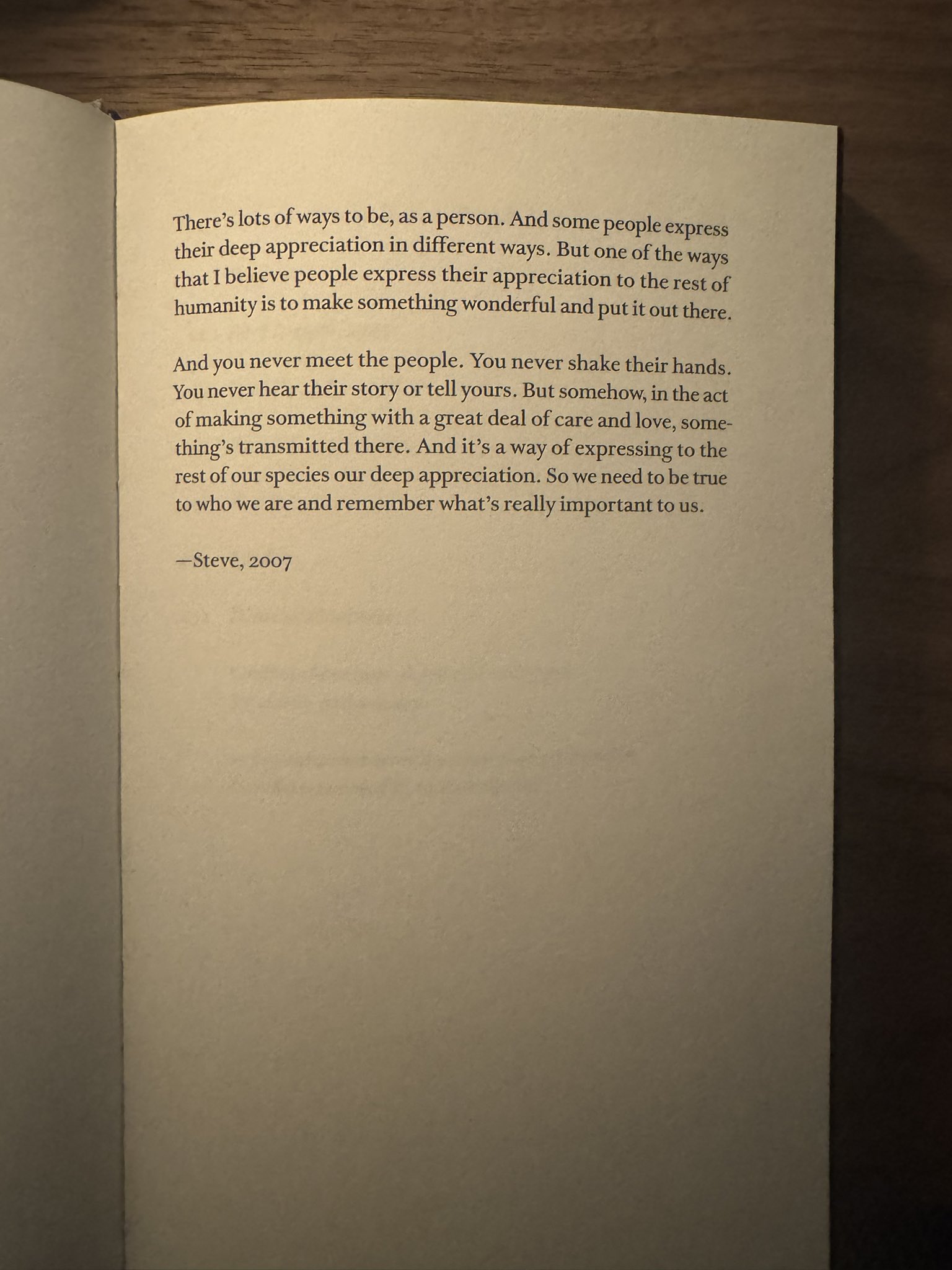
"When you're a carpenter making a beautiful chest of drawers, you're not going to use a piece of plywood on the back, even though it faces the wall and nobody will ever see it. You'll know it's there, so you're going to use a beautiful piece of wood on the back. For you to sleep well at night, the aesthetic, the quality, has to be carried all the way through."

I think this is a great example. Not because Steve Jobs said it. But because there's two ways to see this carpenter:

One is to see him as someone who is afraid of producing a poor quality drawer, because his sense of self worth is tied to the thing he creates to an unhealthy extent. Maybe there is a young part inside of him that wants to use this thing he built as a vessel to fill a deep belonging of wanting to be known, seen, cherished, maybe even admired. This part insists on wanting the world to know that it was him who build it, who made this drawer great. When talking about the drawer he in fact, is talking about himself.

And then there's another way to look at this same carpenter. One that simply does it for the drawers sake.

It's that type of carpenter that pursues excellence for excellence sake, not to be one of the greats. He cares so much more about the thing he does, than who did it.

A carpenter striving for excellence, cannot put this chest of drawers out there without it having a nice back not because it would hurt his ego, but because it does injustice to excellence of the craft itself. The hundreds of years, and people contributing to this shared pile of knowledge, all that work that went into creating and growing the discipline of carpeting itself. A discipline that emerged to create things that improve people's quality of life.

Like him, I don't want to be one of the greats

I am not doing this creative stuff because I want people to remember me for it.

I want people to remember me as being a nice person ALTHOUGH i was doing all of this creative stuff.

I don't want to be remembered because the fact that I worked so hard or the things I created made me a good person.

But as someone who had great care for life and all living things, and put that care into all the things he did. Be it his personal or professional life.

Not to be confused with perfectionism. Perfection is hard to define and attain. But all the love and care you put into something. That is something you can measure, you can control; perfection is not.

So the quest shouldn't be about making things perfect but making them with great care.

Like Jony Ive, I believe that whether in service industry, product consumer, business or whatever, you immediately sense carelessness. When something is just poorly put together.

And like Jony I also think, why then shouldn't we be able to also sense when great care is given into something?

When we have to move our favpority drawer and realise that on the back of it, a beautiful piece of wood, was put.

Writing post image

The Redukt

0:00 / 0:00

If you've read my earlier writing on "form follows function follows feeling," you know I think we're entering a new phase with technology - almost in a Kuhnian sense, a paradigm shift.

For a long time, technology was this very new thing that quickly made its way into our lives, sometimes without us questioning the second-order effects it would have. On us as individuals, as families, as children, but also at a society level. The person who conceived of the car probably didn't think too much about CO2 emissions and climate impact. I don't think there was intentional wrongdoing there - cognitive dissonance is real, and I'm maybe naively convinced that most people do want to build good technology.

But here's the thing: we now have this insane body of knowledge about what happens to our bodies and minds when we use technology. We know about posture from working at laptops. Effects of light on sleep rhythms. How social media rewires our brains.

And younger generations especially - but older ones too - are realizing that interacting with technology often leaves us feeling worse after using it than before. When in reality, the promise of technology was supposed to make aspects of life feel fuller, better, healthier.

And because we know this now, we're starting to see a new kind of product emerge. Hardware that blocks your phone when you need to focus. Software that adds friction before you open social media. Interfaces designed around how your attention actually works, not how companies wish it worked.

Kuhn might say we're in this moment, where we have a little crisis of our old paradigm. So people start to question and to build things differently - tools that respect our natural constraints instead of pushing them past their boundaries in forceful ways.

Some of these products will work, some won't. But they're all reaching toward the same thing: technology that serves not just a function, but also a feeling. Technology designed around our actual physical and mental limits.

I call these products Redukts.

Not because they reduce features (though sometimes they do). But because they reduce technology back to what it usually tries to be - something that makes us live more, not just more efficiently.

Writing post image

Constraints shape Possibilites

0:00 / 0:00

I want to share one of my favorite anecdotes for AI nowadays. László Moholy-Nagy was a core member of Bauhaus, before moving to Chicago and starting the Institute of Design.

His book "Vision in Motion" from 1947 is one of my favorites, and inspiration for many of the writings on here.

One of the most memorable sections of the book is Moholy talking about designers grappling with paradigm changes and the changes they bring to the tools of their everyday craft. He writes that "a designer can best work if he is familiar with the art, science, social and economic requirements of his period plus the industrial processes and the basic mechanical principles involved in a certain problem."

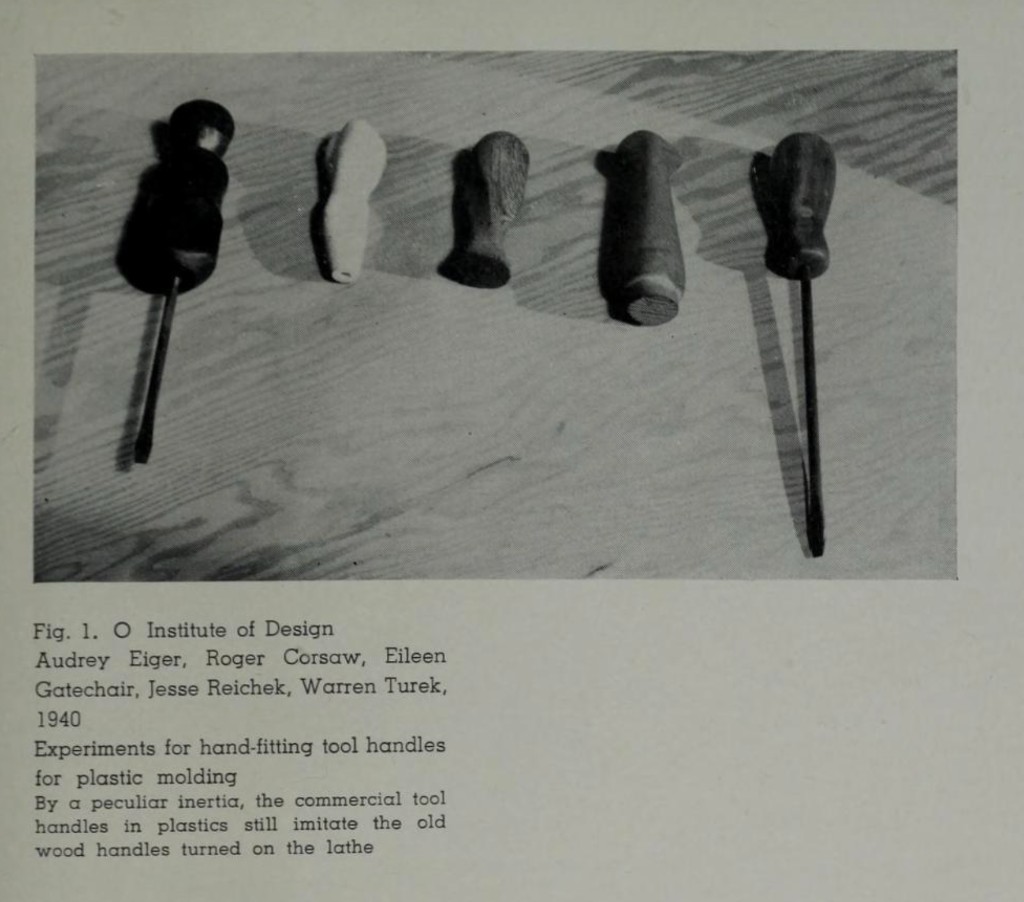
He goes on to explain that back in the day, most household items had handles made out of wood. More specifically, wood turned on a lathe, which in those days tended to produce the most comfortable shape for a tool handle.

Then, after the industrial revolution plastic came along. Yet for decades, the designs of tool handles mimicked the design of wooden ones - only difference being they were made out of plastic.

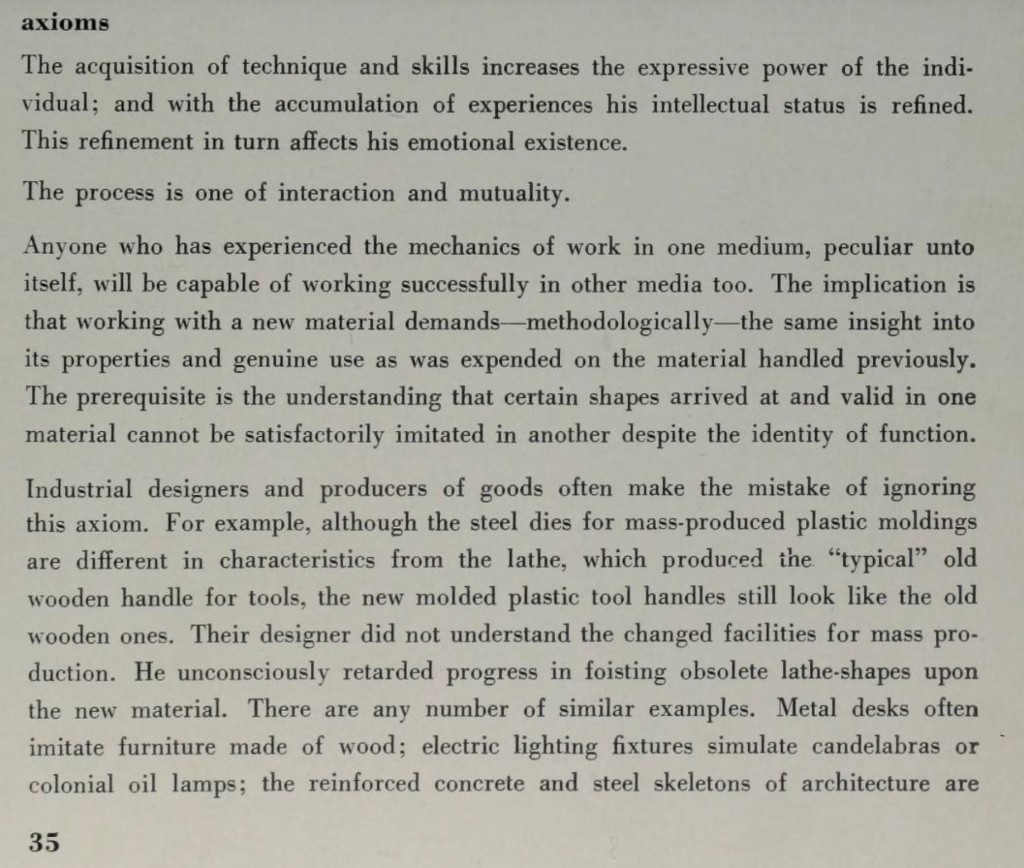
But as Moholy points out: "Industrial designers and producers of goods often make the mistake of ignoring this axiom. For example, although the steel dies for mass-produced plastic moldings are different in characteristics from the lathe, which produced the 'typical' old wooden handle for tools, the new molded plastic tool handles still look like the old wooden ones."

The designer simply "did not understand the changed facilities for mass production. He unconsciously retarded progress in foisting obsolete lathe-shapes upon the new material." It wasn't malicious or lazy. They just couldn't imagine what else a handle could be.

I think this example is so great because partially it mirrors what I at least am seeing in the AI space today. We use AI to generate the same marketing campaigns we did manually before. We recreate movies with AI. Instead of asking ourselves what movie can I make generated by AI, that I couldn't make 20 years ago?

We ask "how can AI write an email like a human?" instead of asking "what new forms of communication are possible?" We want AI to replicate paintings, write novels, compose symphonies - all the old forms. Like those plastic handles pretending to be wood.

Maybe we don't need AI to write better emails. Maybe we need something that isn't an email at all. Maybe we don't need AI-generated oil paintings. Maybe we need art forms we don't have names for yet.

The breakthrough with plastic handles came when enough time and experimentation passed that designers finally understood the material's actual properties - that it could be molded to fit the hand perfectly, that it didn't need to be round, that form could follow function follows feeling.

Same thing will happen with AI.

Our tools, their limitations & possibilites shape the art, design and things we can create.

Eventually we'll stop making it imitate human outputs and discover what it actually wants to be. Until then, we're just making plastic look like wood.

Axioms — acquisition of technique and skills, material and form Institute of Design, 1940 — experiments for hand-fitting tool handles for plastic molding

To our neighbours

When I first spent some time in Tokyo I happened to fall in love with this little Taito region around Sumida river. There was this hostel I was staying at that had a tiny roof one could access. It was before the main holiday season so often I was the only guest up there. Most time I was there, the days got quite hot so I really enjoyed those early nights on that roof.

I remember one night where the sky was surprisingly clear for a city of 30 million people. The hostel staff put up this little hammock one could lie in and I often made it a habit to go up there and listen to some podcasts, one ear plugged in while the other one quietly followed the hum of the city. The algorithm decided to feed me that night with a lot of strange content I remember. That particular day apparently some high up military personnel came through testifying to congress about some covert program in the US, studying some stuff in the sky our militaries cant explain. So about half an hour later my feeds were plastered with UAP content as we seem to call it these days.

And as I surrendered myself to my algorithm and decided to listen through some of these interviews, podcasts, etc. this weird window in my brain opened up. With all the obsession or aversion we sometimes tend to have towards this big question, I remember looking up at those three stars, as I was listening to all of this, and trying to imagine what it would be like to know that there would be someone or something out there.

I dont know how or why but instead of seeing it as a big revelation, as this world changing moment or whatever, it reminded me of a feeling from way way back in my life. Around the time I was born my family got a little house on the countryside. Somewhere deep in my brain there must have been a first memory. And likely, one of these first memories must have been at this cabin. And somewhere in that memory, barely conscious Lukas together with his older brother must have learned from his parents that in this other house, right across the street, there is this other family, with children just our age. And somewhere in that memory this feeling must have arisen in me, that I was now feeling twenty plus years later on this rooftop in Tokyo.

At that time this cabin, just as my parents and brother, must have likely felt like the entire world to me. I dont know how infants experience birth but something tells me that being born into this world full of things incomprehensible to you, takes some time getting used to. And just as young Lukas finally managed to get used to this cabin and the people in it, the idea of this whole other world existing just across the street, must have been both exciting and terrifying to him. But not many years later, that world opened up and had simply become part of mine, or just expanding what mine meant. Whether a continent, a planet or the kids across the street. The world doesn't change, only the edges of it do.

I dont know whether we have neighbours. And while my belly is telling me we might be in for a surprise in the not so distant future, just as then, I dont know whether we even want to have neighbours. Whether it would be nice, bad, weird or terrible. But what I did feel that night, was that against all odds it would end up being just another thing we would need to get used to. Or depending how you see it, that we would be lucky enough to need to get used to.

So to our neighbours. I hope, wherever you are, you are getting used to us too.

To our neighbours